
New apprentice incentives can help with the cost, but finding and developing the right person is where the real value lies
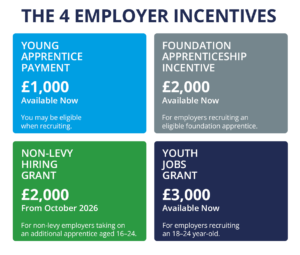
If you’re thinking about hiring an apprentice in 2026, there is more financial support available to employers than you might realise. Government apprenticeship incentives for employers include a £1,000 payment for apprentices aged 16-18 at the outset of their apprenticeship, fully funded training for all new apprentices aged 16-24 and, from October 2026, a new £2,000 hiring payment for eligible non-levy employers recruiting apprentices aged 16 to 24. These incentives are “stackable”. But, whilst these incentives can make taking on an apprentice more affordable, I think there’s a much bigger reason for employers to take notice.
And that’s the opportunity to find someone with potential and develop them into exactly the sort of person your finance team needs. However, recruiting someone without that potential merely for the incentives is a false economy.
So, what’s changing?
There’s quite a lot happening with apprenticeship funding at the moment, and I appreciate that phrases such as funding rules, non-levy employers and eligibility criteria aren’t necessarily the most exciting things to read over your morning coffee.
But some of the changes are worth knowing about.
Employers can already receive a £1,000 payment when they recruit an eligible apprentice aged 16 to 18, or an eligible 19 to 24-year-old with an Education, Health and Care Plan (EHCP) or care leaver status.
Also, don’t forget that one doesn’t have to pay Employers NICs for apprentices aged under 25.
With effect from this August, the 0% employer contribution for those aged 16-24 when starting their apprenticeship has been extended from just SMEs to all employers, including levy payers. This is part of the government’s youth policy.
And then there’s a new incentive arriving in October.
The new £2,000 apprentice hiring payment
From 1 October 2026, non-levy paying employers will be able to receive a £2,000 hiring payment when recruiting an eligible new apprentice aged 16 to 24.
The latest government funding rules confirm that the apprentice must start their apprenticeship from 1 October 2026 and have started their job with the employer within the previous three months. The payment will be made in two instalments, with eligibility for the first payment after the apprentice has completed their first 90 days.
You can read the latest details in the Government’s 2026 to 2027 apprenticeship funding rules.
For a smaller employer thinking about bringing somebody new into an accounts team, £2,000 is certainly not insignificant.
But I wouldn’t recruit simply because somebody is offering me £2,000.
The incentive should be the bonus, not the reason
I’ve worked with apprentices and employers for a long time, and one thing I’ve learnt is that the best apprenticeship relationships aren’t built around funding.
They’re built around people.
The incentive may make the decision to recruit a little easier. It might help with some of those initial employment costs. And for a business that has been sitting on the fence about whether now is the right time to take somebody on, it could provide a useful nudge to tip the balance.
But the real return comes much later.
It’s seeing someone who perhaps arrived with very little accounts experience gradually become more confident. They start taking responsibility for tasks. They understand why they’re doing something rather than simply following instructions. And, eventually, you realise that the trainee you took a chance on has become a genuinely valuable member of your team.
That’s worth considerably more than £2,000.
You don’t necessarily need to recruit an accountant
This is something we talk about a lot at Accountancy Learning.
When recruiting a trainee, employers can understandably start looking for evidence of accounting knowledge. Has the candidate studied accounting before? Have they used accounting software? Do they know their debits from their credits?
Those things can be useful.
But they’re also things we can teach.
It can be much harder to teach someone to be curious, reliable, willing to learn and comfortable asking questions when they don’t understand something.
That’s why I think recruiting for attitude and aptitude can be so important.
We’ve seen plenty of people who didn’t initially look like the obvious future accountant go on to have very successful careers. Sometimes they simply needed somebody to give them the opportunity to find out what they were capable of.
Our Accountancy Talent Programme has been designed with exactly that in mind, helping potential trainees explore accountancy while giving employers another way of finding people who have already shown an interest in the profession. As part of this, we have a Bookkeeping Taster Course and Aptitude Test, which we also provide for free to our clients. It can be an invaluable part of one’s recruitment process.
Getting the apprentice through the door is only the beginning
There’s another point in the employer incentives information that I think is particularly important.
It talks about early support and retention, and stresses that incentives need to lead to starts, progression and sustained employment rather than simply encouraging employers to recruit.
I couldn’t agree more.
Recruitment gets somebody through the door. What happens afterwards determines whether the apprenticeship really works.
An apprentice needs time to learn, opportunities to practise what they’re learning and people around them who are prepared to answer questions and gradually give them more responsibility.
They also need good training and support.
When those things come together, an apprenticeship isn’t simply a way of gaining a qualification. It becomes a way of developing someone whose knowledge grows alongside their understanding of your particular business. Each of our apprentices have a personal tutor who support them throughout their apprenticeship, often supporting them through successive levels 2, 3 and 4. They will generally be in contact with their apprentices every week and organise regular progress reviews with the employer. Do make full use of this contact to really drive progress.
All apprenticeships programmes identify a range of required criteria for Knowledge, Skills and Behaviours. Under the current apprenticeship reforms, from this summer, the assessment of Knowledge and Skills will remain with the Awarding Organisations, e.g. AAT. However, employers will be responsible for verifying Behaviours. Skills England believe that they are better placed to perform this as they see these Behaviours develop first hand. We are planning to work with you to really integrate this “verification” requirement into your own processes.
We see this as opportunity to really add value to the apprenticeship process and allow us both to really enhance the value of your apprentices to your organisation.
Perhaps 2026 is the year to grow your own
Recruiting experienced accounts staff isn’t always easy. And if every employer is searching for someone who already has the experience they need, we’re all fishing in a fairly small pond.
Apprenticeships give employers another option.
Instead of waiting for the perfect candidate to appear, you can find someone with potential and help them develop the technical skills, experience and confidence they need.
The financial support available in 2026 makes that option even more attractive. Quality and progression matter, with the ultimate aim being sustained, skilled employment.
For me, that’s the bit that matters most.
£1,000 or £2,000 might help you recruit an apprentice. Developing the right apprentice could benefit your business for years.
If you’ve been thinking about growing to your team, this could be a very good time to have the conversation.
Get in touch with Accountancy Learning and we’ll help you look at the options, understand the funding available and agree on the best apprenticeship programme for your business. We can also help you find that talented prospect if you wish.
Contact us on 01392 435349 or [email protected] to start the conversation today. Alternatively, if you still want to mull things over, have look at our website https://apprenticeships.accountancylearning.co.uk/